AI TOOL / #02886
Scrapybara
Remote desktop instances designed for use with AI agents, featuring a unified API and low-level control capabilities.
Introduction
Remote desktop instances for AI agents with unified API and low-level controls.
What is Scrapybara?
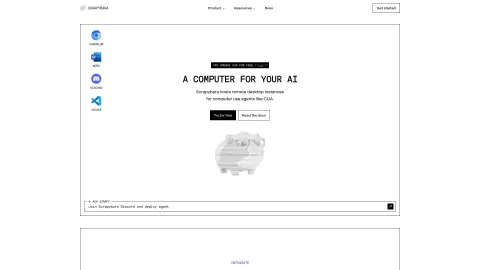
Scrapybara provides remote desktop instances for computers using proxies such as CUA and Claude Computer Use. Through a unified API, developers can use any available model to execute proxy tasks with just one line of code, and gain access to low-level controls such as browsers, file systems, and code sandboxes. Scrapybara handles automatic scaling, authentication, and system environment management, enabling users to deploy proxy queues in production environments and automate any type of computational task.
How to use Scrapybara?
Developers can use Scrapybara by installing its Python or TypeScript SDKs. After initializing the client, they can launch an Ubuntu instance and then utilize the `client_act()` method along with various tools such as ComputerTool, BashTool, and EditTool, along with a specified AI model like OpenAI, to execute automated tasks—for example, web scraping operations.
The core functions of Scrapybara
Remote desktop instances used for AI agents
A unified API that allows agents to be used with any model.
Low-level controls (browsers, file systems, code sandboxes)
Automatic scaling, authentication, and system environment management
Instantly launch a desktop instance.
Browser capabilities, code execution abilities, and file system functionality
Hundreds or thousands of instances can be launched within milliseconds.
Low latency in computational operations
Interactive streams for monitoring and control
Authenticated access is required to save and load website content.
Session persistence enables the suspension and resumption of instances.
Related
CIO Civil Engineering Database
Compiles materials related to civil engineering and professional certification exams, targeted at both practitioners and individuals preparing for these examinations.
PPTist Online Presentation Tool
PPTist is an online presentation editor that allows for slide editing, the use of templates, and file exports. Its interactive features are quite similar to those of desktop software.
Special Topic Database – Literature and Data Platform on the War of Resistance against Japanese Aggression and Modern Sino-Japanese Relations
The work related to the collection and preservation of historical documents and materials by the Chinese People's Political Consultative Conference was an initiative personally promoted and developed by Comrade Zhou Enlai in April 1959. This endeavor is characterized by its strong ties to the united front approach and has become a regular and fundamental task for organizations at all levels of the CPPCC. Over the past half century, this work has gone through four stages: establishment and foundation-laying, restoration and promotion, expansion and development, and innovation and prosperity. To date, nearly 8 billion words of historical materials have been collected, and more than 5 billion words have been edited and published, resulting in the creation of a precious treasure trove of historical documents related to modern Chinese history.
Tsinghua University TUNA Mirror Site
An open-source software mirror website maintained by the TUNA Association at Tsinghua University, which provides domestic users with accelerated downloads of various open-source software and system mirrors. When access via public networks or dynamic IPs is restricted, users can try again using network environments such as IPv6.
Polar Pixels: Panoramic View of Guangzhou
The 80-billion-pixel super panoramic map of Guangzhou offers a view of the entire city from a height of 600 meters at the Canton Tower, providing the perfect perspective to admire this ancient city.
Stanford CS229: Machine Learning
A quick reference guide and course materials for Stanford’s CS229 machine learning course, including explanations of model evaluation methods such as the confusion matrix.