AI TOOL / #10780
Colossyan Creator
An AI video platform used for creating training and workplace learning videos from text.
Introduction
AI video platform for creating training and workplace learning videos from text.
What is “Colossian”?
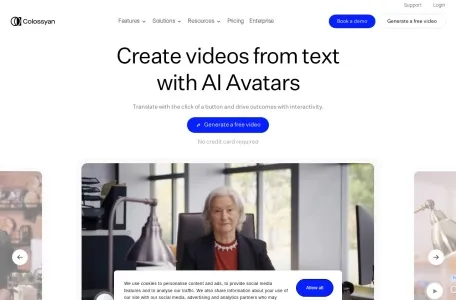
Colossian is an AI-based video platform that enables users to create training and professional learning videos from text. It offers features such as AI-generated avatars, voiceovers, translation services, and interactive elements, all of which help simplify the video production process at minimal cost. Many well-known companies utilize Colossian to produce engaging and effective learning materials.
How to use Colossian?
Users can create videos by selecting an AI-generated avatar, entering the text that the avatar should display, and utilizing various features such as translation, quizzes, and branding options to customize the video content. The platform also supports integration with Learning Management Systems (LMS) via SCORM standards.
The core functions of Colossian
AI avatar
AI voices (over 600 types, in more than 80 languages)
AI Script Assistant
Converting documents into videos
screen recording
Brand Toolkit
Collaborative workspace
Translation function
SCORM integration
quiz
Branch scenario
Analysis tool
Related
question bank
We offer a vast collection of technical interview questions, covering topics such as algorithms, data structures, and system design—with over 1,000 questions in total. These resources will help you efficiently improve your programming skills and enable you to easily secure offers from top global IT companies.
Course Homepage for Li Dongfeng, School of Mathematical Sciences, Peking University, Spring 2026 Semester
Note: I have retired. This website contains some lecture notes, programs, and reference materials from previous years. Please feel free to offer your comments and suggestions. Financial Time Series Analysis (Spring 2026): Textbook: Use Ruey S. Tsay’s “Introduction to Financial Data Analysis: Using R Language”.
Koala New Media Navigation
Koala New Media Navigation includes over 100 essential tools for new media professionals, such as public account layout tools, royalty-free image libraries, strategies for rapid growth, community management tools, Douyin data analysis tools, and creative H5 design resources. It also features more than 200 valuable articles on various topics related to new media, including user acquisition strategies, event management, ways to increase followers on Douyin, data analysis techniques, and recommended reading lists for new media workers.
iFlytek Document Processing Service
iFlytek Document Writing is an AI-based platform designed for document preparation and writing, developed based on the iFlytek Starfire Large Model. It provides assistance throughout the entire process – from material collection to manuscript drafting and review – thereby enhancing the efficiency of content creators. By continuously analyzing common requirements in routine work scenarios, the platform has also introduced recording functionality.
Zhu Bajie Network
Looking for high-quality corporate services? Visit Zhubajie.com. We offer over 800 different types of premium services, including brand design, marketing strategy planning, website construction, intellectual property management, business and financial assistance, as well as digital asset transactions. With 18 years of experience in providing professional corporate services and a network of more than 300 physical service locations, you can trust us to deliver what you need – clear prices and a money-back guarantee if the results don’t meet your expectations.
Notes on Machine Learning Techniques (5)
At the end of the section on Kernel SVMs that was discussed earlier, the issue of overfitting was mentioned. The reason for this is that the classification boundary that SVMs aim to find must separate all the training data—whether there are some noisy data points or data with incorrect labels, this boundary still has to strictly maintain the separation between them. As a result, this can lead to the formation of very complex boundaries.